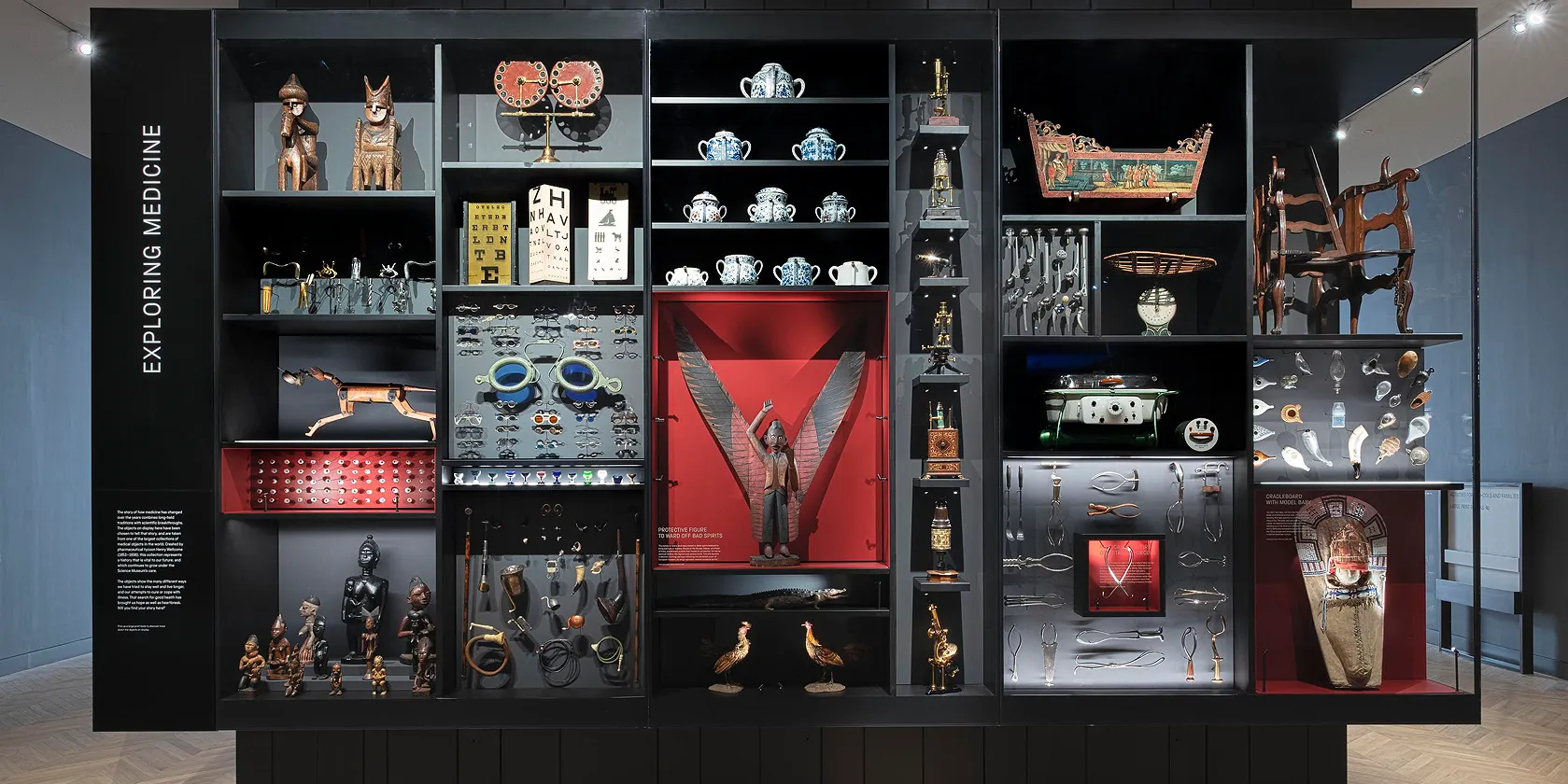
Location Science Museum, London / Designers: Wilkinson Eyre / Fit-Out: Paragon / Images © Science Museum Group
Developed as part of the Science Museum galleries, these extra-long structural showcase systems were designed to fulfil two critical functions within a single integrated solution. As well as providing conservation-grade environments for a diverse range of mounted artefacts, the showcases also form the primary safety barrier protecting the central gallery void below. This presented a complex engineering challenge, requiring structural safety, conservation performance, operational access and architectural aesthetics to be carefully balanced.
Working closely with the client team, designers and engineers, Click Netherfield developed an innovative showcase system that would meet these demanding requirements while maintaining the clean, minimal appearance of the surrounding gallery architecture. The design incorporates large-format glazed assemblies with minimal visible structure and carefully engineered mitred glass junctions, creating uninterrupted sightlines across the gallery while concealing the substantial structural framework required to support the showcases under public loading conditions.
A key challenge emerged around object access. The original concept proposed front glazed panels operating on drawer runner systems, but concerns were raised regarding their structural stability, performance under public loading and the long-term alignment of the upper glass edges following repeated operation. In response, Click Netherfield developed an alternative motorised lifting system capable of raising the complete glazed showcase assemblies vertically. This provided significantly improved access for object installation and ongoing maintenance, while also delivering greater structural integrity and operational reliability.
The lifting mechanism was carefully integrated into the showcase design to preserve the all-glass aesthetic. Concealed structural steel frameworks were incorporated within the base construction, while the lifting elements were hidden within the internal showcase ends and finished to complement the object mounting systems. This allowed the showcases to retain their uninterrupted glass surfaces and refined architectural appearance without compromising the engineering requirements of the system.
Safety was another fundamental consideration. Because the showcases also act as a barrier to the gallery void, safe access had to be maintained whenever the glazed assemblies were raised for installation or maintenance. A bespoke retractable barrier screen system was therefore developed alongside the lifting mechanism. The screens provide a secure temporary barrier during operation, eliminating fall risks while remaining completely concealed during normal gallery use.
Achieving this balance required extensive technical coordination and iterative design development. Structural behaviour, lifting tolerances, operational sequencing and safety requirements were reviewed and validated through engineering studies, prototype development and technical reviews before the system was released for production. Multiple integration studies were also undertaken to determine how the lifting mechanisms and structural components could be incorporated without disrupting the architectural intent of the galleries.
The result is a highly integrated showcase solution in which structural performance, conservation, safety and accessibility are resolved within a single architectural system. Through close collaboration with the client and design teams, Click Netherfield transformed a complex structural and operational challenge into a refined showcase solution that provides robust protection for both the displayed objects and the public, while maintaining the minimal visual intervention required within the gallery.
“The gallery proves to be popular and something we too are incredibly proud of!”
Keeley Carter
Science Museum Group