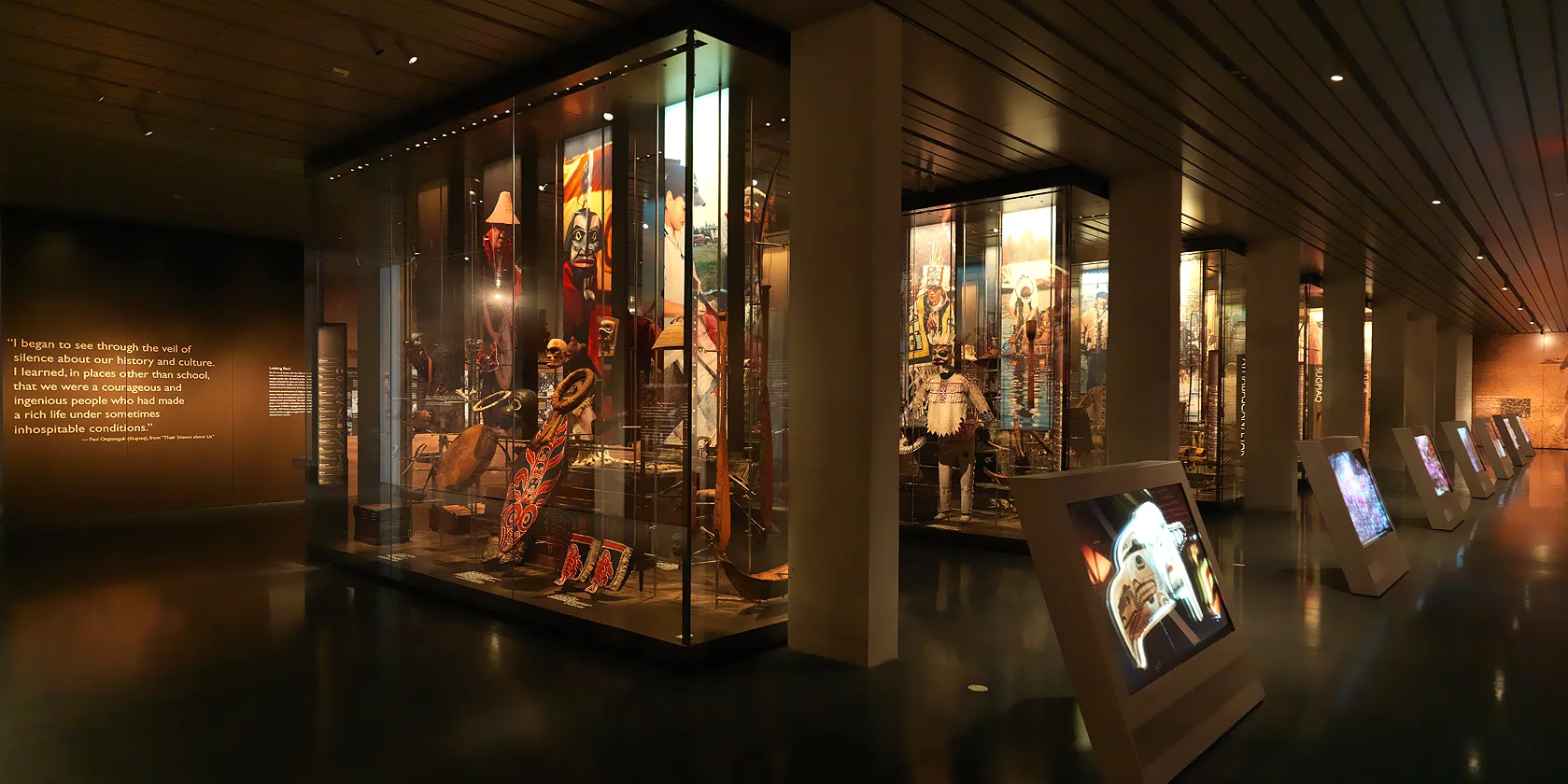
Location Smithsonian Arctic Studies Center, Anchorage / Designers: Ralph Appelbaum Associates / Fit-Out: Kubik Maltbie
The Smithsonian Institution’s only embedded center within another museum anywhere in the world, the Arctic Studies Center is an integral part of the expansion of the Anchorage Museum at Rasmuson Center. Developed in collaboration with Ralph Appelbaum Associates, Click Netherfield and Maltbie were engaged from the earliest stages of the project, providing consultancy on case design, materials testing, prototype construction and review in New Jersey, as well as addressing earthquake-zone structural engineering requirements.
The Arctic Studies Center’s exhibitions comprise more than six hundred rare Native Alaskan objects on long-term loan from the National Museum of the American Indian and the National Museum of Natural History. The opening of the Center marked the return of these artifacts to Alaska, and for many, the first time they had been exhibited in their home state or anywhere in the world in over 150 years.
Click Netherfield engineered, fabricated and installed ten massive showcases for the Arctic Studies Center. Seven of these are Community Cases, representing the diversity of Native Alaskan communities with artifacts specific to each. The remaining three are Thematic Cases, grouping objects by type. Working in conjunction with Maltbie, Click Netherfield developed a custom object mounting system of stainless steel rods and fabricated brackets that safely support artifacts while allowing 360° visibility.
The cases are remarkable in several ways: their scale (the Community Cases measure 17.5 feet wide by 6 feet deep by 12 feet 4 inches tall, with the Thematic Cases only slightly smaller); their engineering, designed in partnership with BBFM Engineers to withstand the seismic demands of Alaska while meeting the stringent safety requirements of the Smithsonian; and their construction, which required structural connections above and below doors to be completed before the museum received its building completion certificate.
Although appearing to rest on the museum floor, the showcases are in fact suspended from the third-floor slab, enabling them to move independently during an earthquake.
For practical access, each twelve-foot-high case is equipped with a pneumatic, motorized opening system, combining functionality with a refined finish and giving curators unparalleled ease of access to the artifacts.
“After working alongside Click Netherfield for more than 5 years in pre-construction, design development, fabrication and ultimately installation of the enormous glass showcases, the end result is absolutely terrific.”
Chuck Maltbie
President
Kubik Maltbie